 Nightlore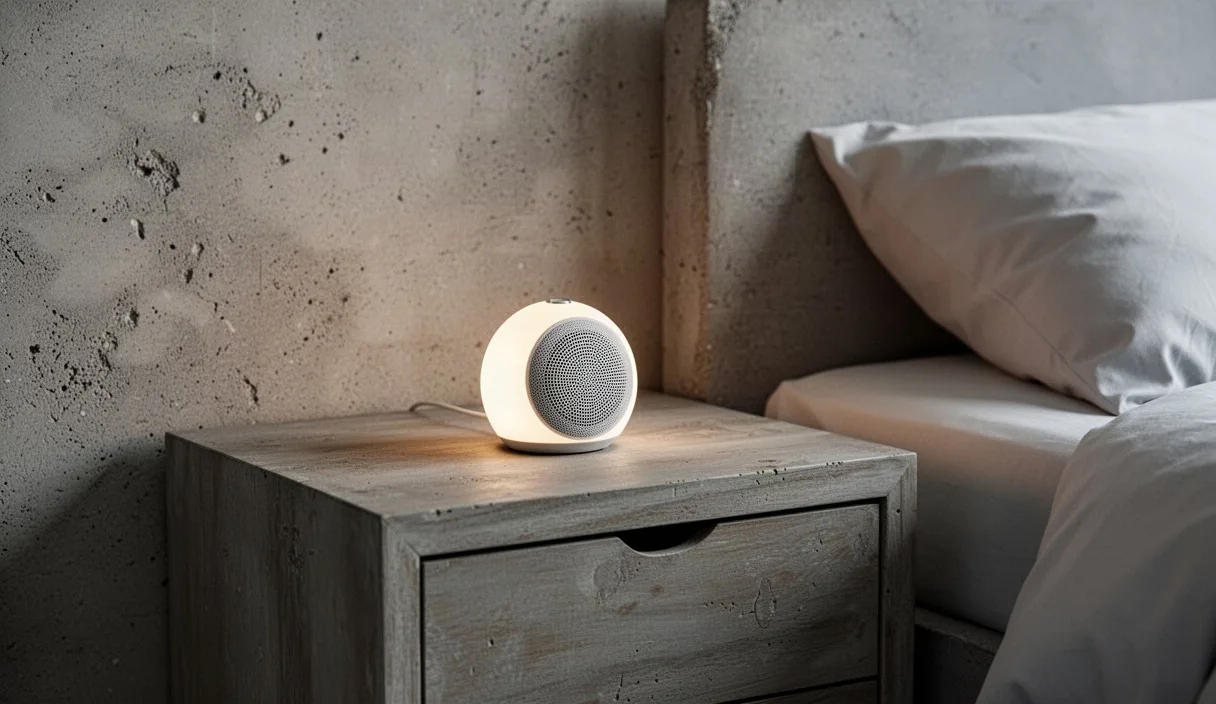
The market for sleep sound machines has expanded well beyond the tabletop fan-noise generators of a few decades ago, and the vocabulary has expanded with it. Shoppers now encounter "pink noise" marketed as a superior alternative to plain white noise, along with claims that certain frequencies can deepen sleep or improve memory consolidation overnight. Some of this rests on genuine acoustic research; some of it is extrapolation from small studies dressed up as settled science.
This article separates what is reasonably well supported from what remains speculative, and offers a practical framework for deciding whether background sound belongs in your bedroom at all. None of it substitutes for advice from a sleep specialist or audiologist if you have chronic restful sleep support, tinnitus, or hearing sensitivity concerns.
What white noise, pink noise, and silence actually are
White noise contains equal energy across all audible frequencies, which is why it sounds harsh and hissy compared to the ocean-like quality of a fan or air conditioner. Pink noise reduces energy at higher frequencies by roughly 3 decibels per octave, producing a deeper, more balanced sound that many people describe as closer to rainfall or steady wind. Brown noise (sometimes called red noise) drops off even more steeply and sounds like a low rumble, similar to a distant waterfall or thunder.
"Silence" in a bedroom context is rarely true silence. Most rooms carry an ambient noise floor between 30 and 40 decibels from HVAC systems, traffic, plumbing, or a partner's breathing. What people mean when they say they sleep in silence is usually the absence of intermittent, unpredictable sound rather than the absence of all sound energy.
The practical distinction that matters for sleep is not the color of the noise but its consistency. A steady broadband sound, whatever its spectral shape, masks sudden changes in the acoustic environment. A door closing two rooms away, a car alarm, or a snoring transition are the events that tend to wake people, and a consistent background sound reduces the contrast between baseline and disruption.
What the research supports for noise masking
The strongest evidence for background noise in sleep contexts comes from hospital and ICU studies, where continuous ambient sound has been shown to reduce the number of arousals caused by equipment alarms and staff conversation. A frequently cited study from Brigham and Women's Hospital found that pink noise reduced the probability of waking from sudden sounds in a controlled lab setting, though the effect size was modest and the sample size was small (fewer than 20 participants in the core arousal-threshold experiment).
Outside clinical settings, the case for noise masking is largely about environmental noise pollution rather than sleep architecture improvement. If you live near a street with irregular traffic, a masking sound raises the threshold at which those irregular sounds register as disruptive. This is functionally similar to how tinnitus sound therapy uses steady background noise to make the ringing less noticeable by comparison.
Where the evidence is thinner is on whether masking noise improves sleep for people who do not have a specific noise problem. Several small trials on white noise for infants found improved sleep onset time, but results in healthy adults without noise disruption are inconsistent, and a few studies found no measurable benefit over silence when the room was already quiet.
- Masking is most useful when the disruptive event is unpredictable and moderate in volume, not when it is loud and constant (a masking sound will not out-compete a jackhammer).
- The benefit is proportional to how noisy your environment already is; someone in a quiet suburban bedroom has less to gain than someone above a bar or near an airport flight path.
- Volume matters more than color: most audiologists suggest keeping masking sound under 50 decibels, comparable to a quiet conversation, to avoid contributing to hearing strain over years of nightly use.
Claims about deep sleep enhancement examined
A 2017 pilot study out of Northwestern University, often cited in marketing copy, applied precisely timed pink noise pulses synchronized to slow-wave oscillations in 13 older adults and reported improved memory test scores the following morning. This is a legitimate and interesting finding, but it is frequently misrepresented. The study used closed-loop stimulation, meaning the sound pulses were triggered by real-time EEG readings and timed to specific brainwave phases, not a consumer sound machine playing continuous pink noise all night.
No commercially available white noise or pink noise machine on the market performs this kind of phase-locked stimulation. A speaker playing a loop of pink noise from 11 p.m. to 6 a.m. is doing something categorically different from a lab setup wired to an EEG cap, and claiming the consumer product produces the same deep-sleep or memory benefit is not supported by the study's own methodology.
Follow-up research attempting to replicate closed-loop acoustic stimulation has shown mixed results, with some studies finding modest slow-wave enhancement and others failing to reproduce clear memory improvements. The field considers this an active and unsettled area, not a proven consumer benefit. If a sound machine's packaging references "clinically proven deep sleep enhancement," it is worth asking whether that claim traces back to closed-loop EEG research that has no bearing on a static playback device.
The honest summary is that continuous pink or white noise may help you fall asleep faster or stay asleep through minor disruptions, but there is no credible evidence that playing it all night restructures your sleep stages or measurably deepens slow-wave sleep on its own.
When background sound helps and when it does not
Background sound tends to help in a fairly narrow set of circumstances, and it is worth being specific about them rather than treating masking noise as a general sleep aid.
| Situation | Likely to help | Likely no meaningful effect |
|---|---|---|
| Irregular street or neighbor noise | Yes, masks unpredictable peaks | |
| Living with a snoring partner | Sometimes, reduces contrast of snore sound | |
| Tinnitus-related sleep difficulty | Often reported helpful by users | |
| Already quiet bedroom, no noise issue | Yes, little added benefit | |
| Anxiety-driven restful sleep support | Sound may distract briefly but does not address underlying cause | |
| Shift workers sleeping in daytime noise | Yes, especially combined with blackout curtains |
There is also a habituation risk worth mentioning. Some people become dependent on background noise to fall asleep, meaning travel, power outages, or a broken machine can trigger sleep-onset anxiety that did not exist before the habit formed. This is not a reason to avoid sound machines, but it is a reason to view them as a tool for a specific noise problem rather than a permanent nightly requirement.
Choosing based on your specific environment
The right choice depends less on brand claims and more on an honest audit of what is actually disrupting your sleep. A few practical starting points:
- If your problem is traffic or street noise with a lot of low-frequency rumble (trucks, buses), brown noise or pink noise tends to mask it more effectively than white noise, since it has more energy in the lower register where that noise sits.
- If your problem is higher-pitched intermittent sounds, such as a partner's phone notifications or a dog barking outside, white noise's flatter spectrum covers a wider range and may work better.
- If you are not sure what is waking you, a basic decibel meter app can help; anything spiking above your baseline room noise by 10 decibels or more is a plausible culprit worth targeting with masking sound tuned to that frequency range.
- If your room is already under 35 decibels of ambient noise and you are not experiencing fragmented sleep, silence or near-silence is a reasonable default, and adding sound is optional rather than corrective.
People with misophonia or certain sensory processing differences sometimes find pink or brown noise more tolerable than white noise's hiss, though this is individual and worth testing with a short trial period, such as a week, rather than committing to a device before confirming it is not itself irritating.
Practical setup considerations
Placement matters as much as noise color. A speaker positioned near the window or door where disruptive sound enters will mask more effectively than one placed on a nightstand facing away from the source. Distance from the sleeper's ears should be at least a meter to avoid concentrated exposure at one ear over hours of use.
Volume should be measured, not guessed. A phone-based decibel meter placed at head height on the pillow is a reasonable way to check that the machine is not exceeding 50 decibels, which several hearing health organizations cite as a reasonable upper limit for all-night exposure. Machines with a hard cutoff or auto-shutoff after a few hours are worth considering for people concerned about all-night exposure duration, though continuous use overnight is also common practice without documented harm at moderate volumes.
Common mistakes
- Assuming pink noise is universally "better" than white noise; the better choice depends on the frequency profile of the disruptive sound, not a general hierarchy.
- Running a machine at high volume to "make sure it works," which risks contributing to hearing fatigue over months of nightly use at levels above 55 to 60 decibels.
- Buying a machine specifically for claimed deep-sleep or memory enhancement based on closed-loop EEG research that has no relevance to a standard playback device.
- Using noise as a substitute for addressing an actual acoustic problem, such as a window that could be better sealed or curtains that could be added, when a structural fix would resolve the issue more permanently.
For most people, the practical path is a short trial: identify the specific sound disrupting sleep, choose a noise color that covers that frequency range, keep volume under 50 decibels measured at pillow height, and give it a week before deciding whether it helps. If sleep problems persist regardless of the sound environment, particularly if they involve frequent waking, gasping, or excessive daytime fatigue, a conversation with a physician or sleep specialist is a more useful next step than experimenting further with sound equipment.